
Industrial Marking Requirements and Permanent Solutions for CE, FDA, and ISO Standards
For manufacturers delivering products to global markets, compliance with international regulations and quality management systems is an essential requirement. European Union CE conformity marking, US Food and Drug Administration (FDA) regulations, and ISO standards require parts and product bodies to be equipped with tamper-proof, lifelong readable, and uniquely traceable codes. Unlike chemical labels that fade over time, industrial laser and dot-peen marking systems developed with in-house engineering meet these certification requirements fully.
By Erden Arıkan · Mechatronics Engineer
For manufacturers delivering products to global markets, compliance with international regulations and quality management systems is an essential requirement. European Union CE conformity marking, US Food and Drug Administration (FDA) regulations, and ISO standards require parts and product bodies to be equipped with tamper-proof, lifelong readable, and uniquely traceable codes. Unlike chemical labels that fade over time, industrial laser and dot-peen marking systems developed with in-house engineering meet these certification requirements fully.
Why Is Product Marking Mandatory in International Certifications?
Global regulatory frameworks such as CE, FDA, and ISO aim to guarantee product safety, user health, and end-to-end supply chain transparency.
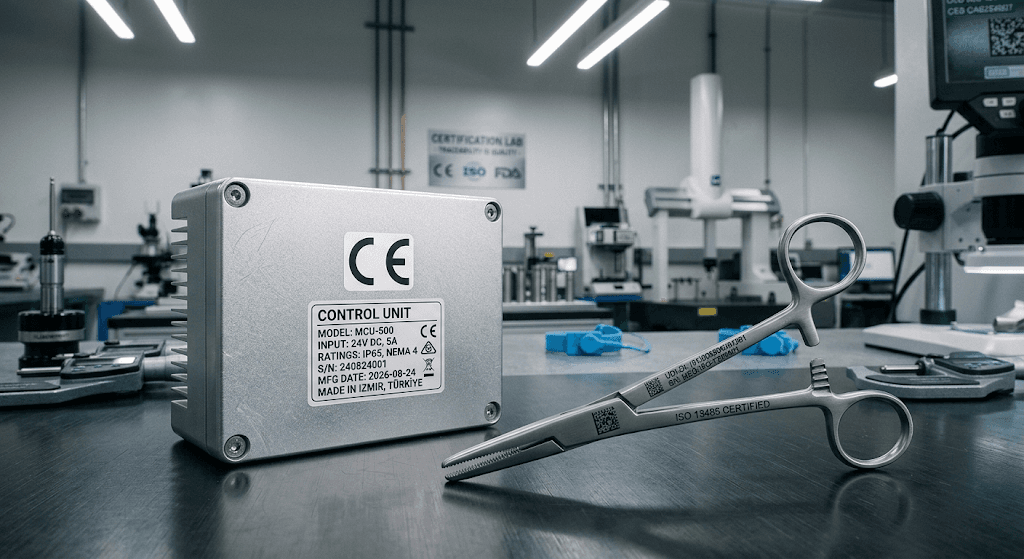
- CE Directives Compliance: In accordance with the Machinery Directive and Low Voltage Directives, the CE logo, manufacturer trade name, model type, and technical voltage/power ratings must be permanently marked on the product body.
- FDA and UDI (Unique Device Identification) Standards: Medical and healthcare devices must feature 2D DataMatrix codes that are resistant to surgical sterilization processes and corrosion.
- ISO Quality Management Systems: Under ISO 9001, ISO 13485, and ISO 22000 standards, the traceability of batch/lot numbers, production dates, and serial codes is audited.
Mandatory Marking Parameters for CE, FDA, and ISO
Key elements required in product labeling and body marking:
- Permanent Logos and Symbols: CE mark, ISO standard logos, and recycling pictograms.
- Manufacturer and Origin Information: Company name, country of origin, address, and authorized representative codes.
- Traceability Codes: Unique serial number, batch (lot) number, manufacturing and expiration dates.
- 2D DataMatrix and GS1 2D Codes: High-contrast digital traceability codes for fast scanning by optical readers.
- Technical and Safety Parameters: Operating voltage, power consumption, warning symbols, and operating instructions.
Selecting the Right Marking Technology for Certification Processes
Methods according to the standards applicable to industrial products:
- Fiber and UV Laser Marking: Ideal for medical devices, surgical stainless steels, delicate electronic PCBs, and aluminum nameplates requiring micron-precision CE logos, micro DataMatrix codes, and smooth annealing.
- Dot-Peen Marking: Provides deep mechanical engraving that remains readable even after sandblasting and electrostatic powder coating on heavy machinery, cast iron bodies, steel profiles, valves, and vehicle chassis (VIN).
Why Do Traditional Labels Fall Short in Certification Audits?
Paper or adhesive foil labels can wear out and peel off over time due to friction, oil, cleaning chemicals, and high temperatures. Products with missing labels face direct rejection or penalty risks in international customs inspections, CE conformity checks, and FDA field audits. In contrast, laser and dot-peen codes marked directly on the part retain their permanence until the product is scrapped.
Full Compliance with Standards Using Dotpeenator and Laserator
Contact us via dotpeenator.com or markalama.com to request free sample marking on your parts.