
Guide to Industrial Coding and Permanent Marking on Plastic, Metal, and Glass Surfaces
What are the industrial coding techniques for plastic, metal, and glass surfaces? Discover fiber laser, UV laser, and dot-peen Dotpeenator permanent marking solutions.
By Erden Arıkan · Mechatronics Engineer
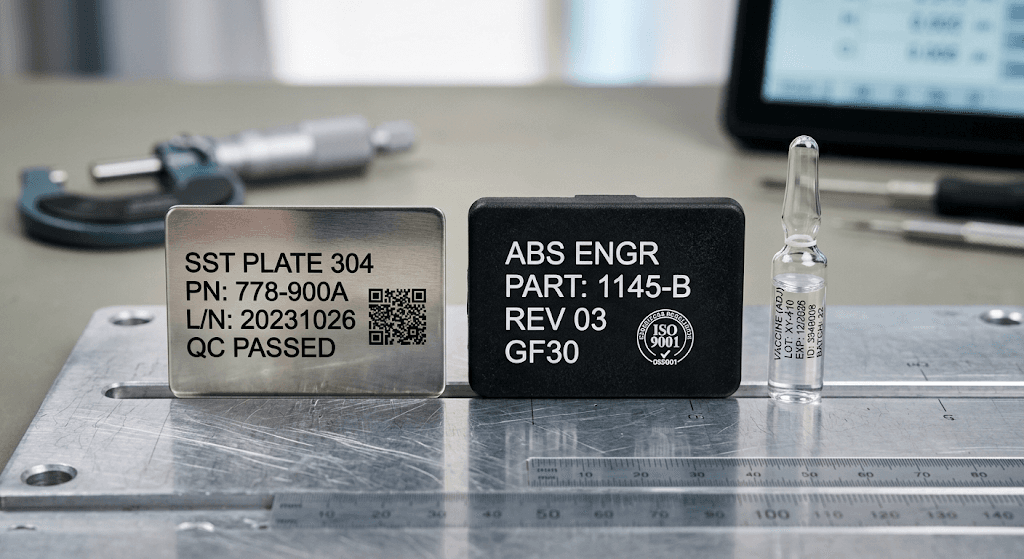
From automotive to electronics, medical devices to packaging, the most commonly used materials in modern production lines are metal, plastic, and glass. Because each material possesses distinct optical absorption rates, thermal conductivities, and surface hardnesses, achieving permanent traceability with lifetime-durable 2D DataMatrix codes and batch numbers depends on selecting the right marking technology. High-speed industrial laser systems and deep mechanical dot-peen marking machines deliver maximum contrast and durability across various material groups with zero consumables.
1. Permanent Coding Solutions for Metals and Alloys
Subjected to high mechanical stress, extreme temperatures, friction, and chemical oils, metal parts present one of the most demanding marking applications:
- Fiber and MOPA Laser Marking: Operates with micron-level precision on stainless steel, anodized aluminum, titanium, brass, and hardened tool steels. Creates black contrast via annealing without compromising corrosion resistance on stainless metals, and produces crisp white codes on anodized layers.
- Dot-Peen (Dot Peen) Marking: Utilizing carbide pin impacts to create mechanical indentations on metal surfaces, this method is ideal for cast housings, profiles, heavy chassis, and pipelines. It leaves tamper-proof, deep mechanical marks even on parts that undergo subsequent sandblasting, hot-dip galvanizing, or electrostatic powder coating.
2. Laser Coding on Engineering Plastics and Polymers
The thermal sensitivity and polymer composition of plastics directly determine the optimal laser wavelength to apply:
- UV Laser Marking (Cold Marking): Thanks to its 355 nm wavelength, it eliminates the heat-affected zone (HAZ), delivering high-contrast photochemical color change without burning or melting on sensitive medical plastics, cable jackets, flame-retardant (FR4) electronic boards, and thin-walled polymers.
- Fiber and MOPA Laser Marking: Produces highly readable light or dark 2D codes on rigid engineering plastics such as ABS, polycarbonate (PC), and filled polyamide (PA) through micron-level foaming or carbonization effects within the material.
- Why Not Ink or TTO?: While traditional thermal transfer (TTO) or continuous inkjet (CIJ) markings are easily wiped off by alcohol, oils, and abrasive friction on plastics, laser marking alters the molecular structure of the polymer itself to guarantee lifelong permanence.
3. Precision Marking on Glass, Ceramics, and Fragile Materials
Transparent, hard, and brittle glass and ceramic surfaces require specialized laser wavelengths:
- UV Laser Technology: Delivers crisp, smooth, and aesthetically pleasing micron-level traceability codes without generating micro-cracks or thermal fracture risks on glass vials, laboratory ampoules, automotive glass, and optical lenses.
- CO2 Laser Technology: Executes high-speed date, batch, and logo engraving on wine bottles, jars, and decorative glass packaging by controlled micro-scale surface frosting/etching.
Ideal Marking Technology Matching by Material Type
- Stainless Steel, Aluminum, Titanium, and Tool Steels: Fiber Laser / MOPA Laser (High speed, annealing, zero consumables)
- Cast Housings, Heavy Chassis, Metals to be Painted/Galvanized: Dot-Peen Systems (Deep mechanical indentation, tamper-proof marking)
- Sensitive Medical Polymers, Appliance Plastics, and Electronic Chips: UV Laser / Fiber Laser (Cold marking, high contrast)
- Glass Bottles, Vials, Ceramic Insulators, and Optics: UV Laser / CO2 Laser (Crack-free micro-coding, smooth surface frosting)
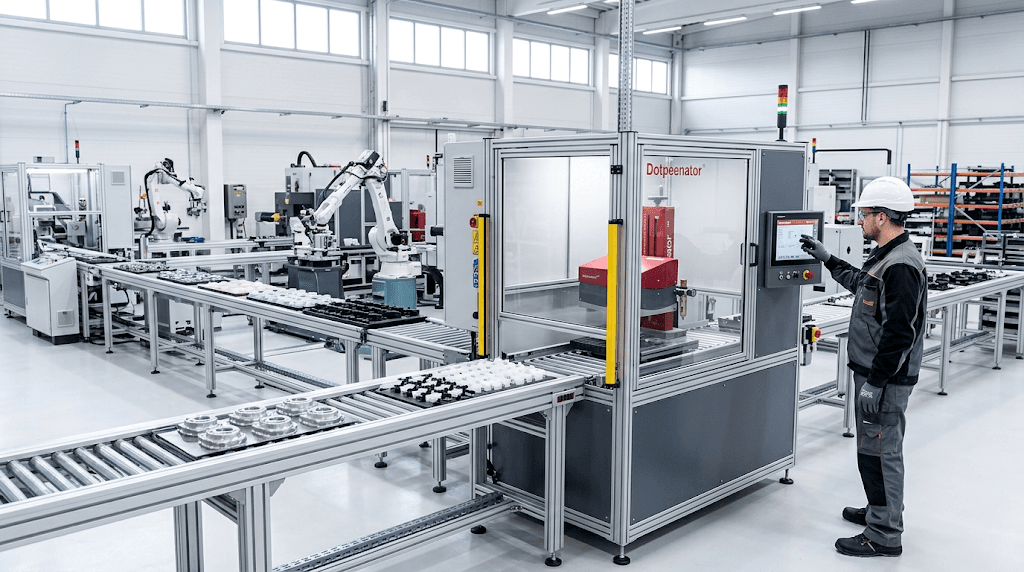
Continuous Efficiency Across Multi-Material Production with Dotpeenator
Manufactured with our in-house engineering expertise, Dotpeenator dot-peen marking machines, Fiber Laser, UV Laser, and CO2 Laser marking systems guarantee maximum readability and durability across all industrial materials—whether plastic, metal, or glass. They minimize your operational expenses with zero consumable costs and a PLC/ERP-compatible smart software architecture.
To determine the optimal marking configuration for the material variety on your production line or to request a free test mark on your metal, plastic, or glass samples, contact our engineering team at dotpeenator.com.