

Desktop Dot Peen Marking Machines (Benchtop Systems)
Dotpeenator™ SA14 Desktop Dot Peen Marking Machine
A plug-and-play desktop dot matrix marking system with an integrated 7-inch touchscreen, eliminating the need for a computer.
View
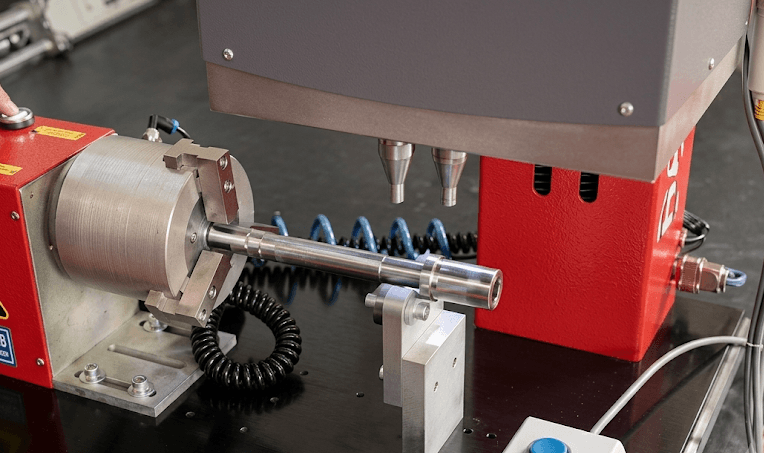
Simultaneous, permanent marking at two separate points on cylindrical barrel surfaces in a single operation, utilizing a custom dual-pin Dotpeenator™ SA14 and a rotary indexer with a pneumatic chuck.
In the defense industry, the barrel is a component subject to mandatory legal traceability. Serial numbers, caliber, and manufacturer information must remain legible throughout the product's operational lifespan.
To meet this requirement, SERMATEK custom-modified the standard Dotpeenator™ SA14 benchtop dot peen marking machine. By integrating a dual-pin marking head, the machine applies identical content simultaneously to two distinct points on the barrel in a single cycle. The cylindrical barrel is positioned and rotated on a rotary indexing axis equipped with a pneumatic chuck, ensuring the marking head maintains a perpendicular angle across every point on the curved surface.
The result: twice as fast cycle times, operator-independent repeatability, and an indelible identity engraved directly into the barrel's metal.
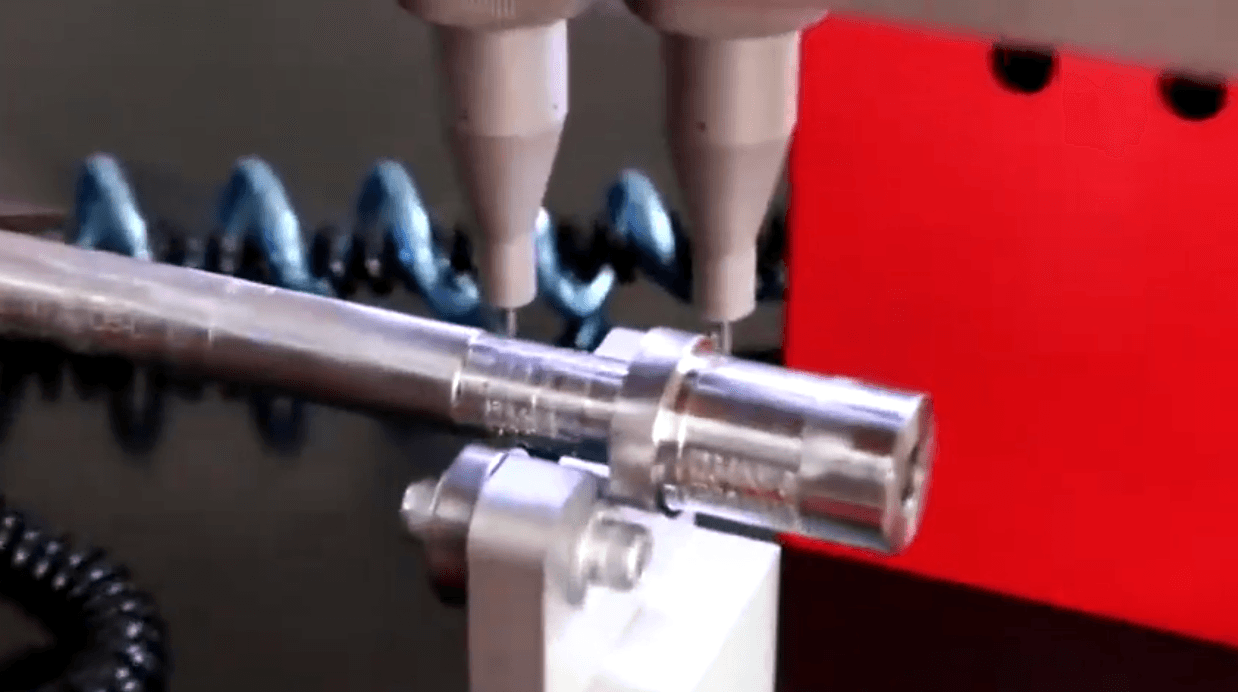
Custom dual-pin marking head — identical content marked simultaneously at two points.
A standard marking machine operates with a single pin: after completing one text, the part is rotated or repositioned, and the cycle restarts for the second text.
In this application, the Dotpeenator™ SA14 marking head was re-engineered by SERMATEK to drive two pins simultaneously. The identical content is marked across two independent points on the barrel at the exact same time and depth.
The benefit extends beyond cycle speed. Because the repositioning step between the two markings is eliminated, the angular and axial relationship between both marks remains perfectly consistent across every single part, eliminating operator-induced variances.
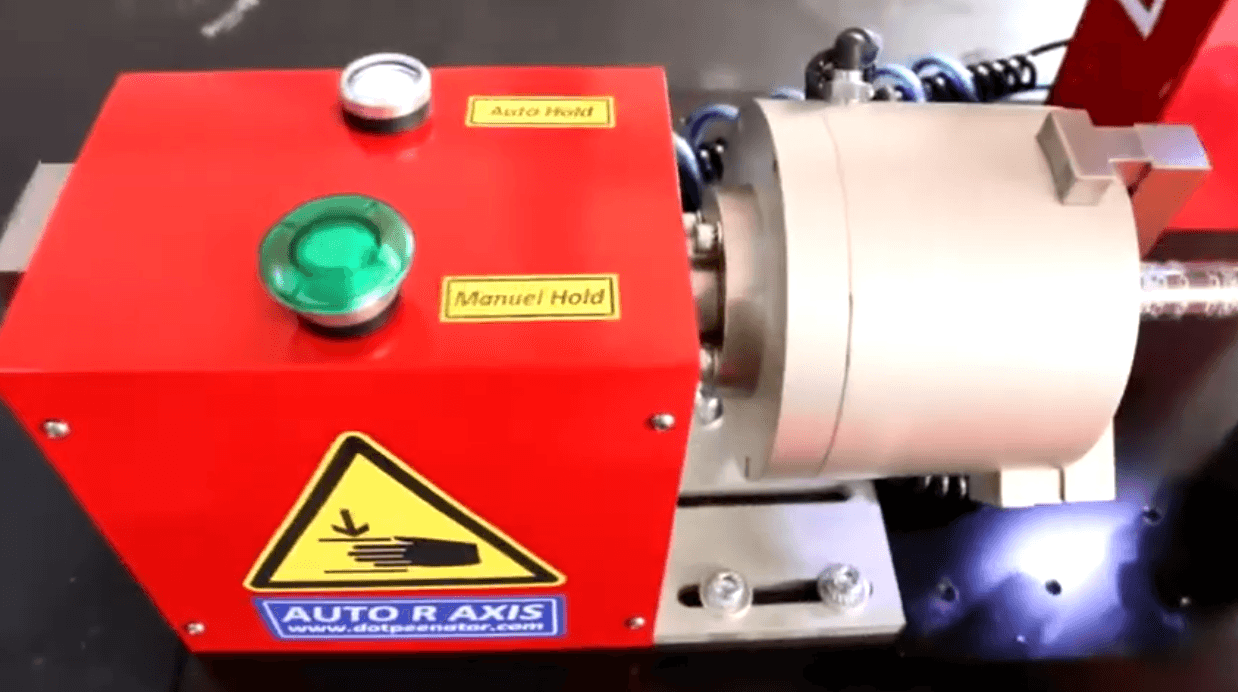
The barrel is centered and rotated in a controlled manner on a rotary indexing axis with a pneumatic chuck.
A rifle barrel is a cylindrical surface, and a dot peen pin achieves its cleanest, most legible mark when striking perpendicular to the surface. Attempting to mark a cylindrical component on a flat fixture results in character distortion toward the edges and inconsistent marking depth.
In this setup, the barrel is mounted onto a rotary indexing axis with a pneumatic chuck. The chuck automatically centers and firmly clamps the workpiece, while the rotary axis rotates the barrel in a controlled manner during marking.
This setup allows perpendicular marking at consistent depth across any angular position around the cylinder's circumference. Furthermore, pneumatic clamping minimizes operator loading and unloading times.
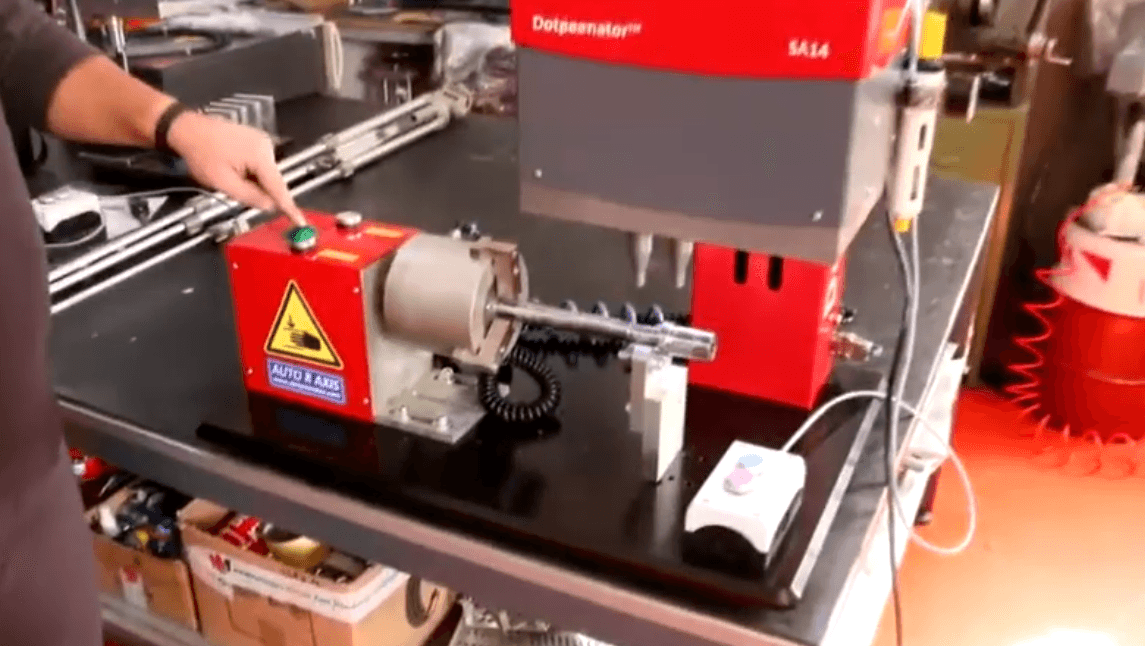
Characters engraved directly into the metal surface — not paint or coating.
Dot peen marking creates characters through the high-frequency physical impact of a carbide-tipped pin onto the metal surface. The mark is formed not by ink or surface coating, but by permanent mechanical deformation of the metal itself.
In the defense sector, this distinction is critical:
Permanence: The marking remains fully legible throughout the product's service life against oils, chemical solvents, abrasion, and aggressive cleaning processes.
Traceability: Serial numbers, caliber, and manufacturer data form an integral identity of the part that cannot be removed or altered.
Zero thermal impact: Unlike laser marking, dot peening is purely mechanical; the metallurgical structure, surface properties, and heat treatment of the barrel remain unaffected.
Low operational cost: The only consumables are the carbide pin and compressed air.
This system was not selected from an off-the-shelf catalog; it was custom-engineered around the customer's specific part geometry, cycle time targets, and marking locations.
SERMATEK develops both the mechanical hardware and control software for Dotpeenator™ systems in-house. Consequently, custom modifications such as dual-pin heads, dedicated clamping fixtures, and rotary indexing integrations are executed without reliance on third parties, with direct technical support and spare parts availability from a single source.
If you are planning a similar application for your manufacturing line, get in touch with our engineering team.
Desktop Dot Peen Marking Machines (Benchtop Systems)
A plug-and-play desktop dot matrix marking system with an integrated 7-inch touchscreen, eliminating the need for a computer.

Rotary Axis and Marking Fixtures for Circumferential Marking
Rotary axis module with pneumatic chuck system for fast, precise and continuous circumferential marking of cylindrical parts in mass production lines.

Pin/Cartridge Sets
A high-stroke pin-cartridge assembly that automatically tolerates surface roughness and level differences of up to 12 mm in pipes, castings, and forged parts.

Pin/Cartridge Sets
An 8mm heavy-duty pin-cartridge assembly that automatically tolerates level differences of up to 18mm on curved, cast, and stepped surfaces.

Accessories
An industrial external control box that enables safe and fast management of marking operations from right next to the work area.